







Choosing a Deployment Model for Spatial Intelligence in Malaysia
Spatial intelligence deployment model compared for Malaysia: hub-integrated, edge-deployed and cloud-hosted, covering data residency, outages and workload.
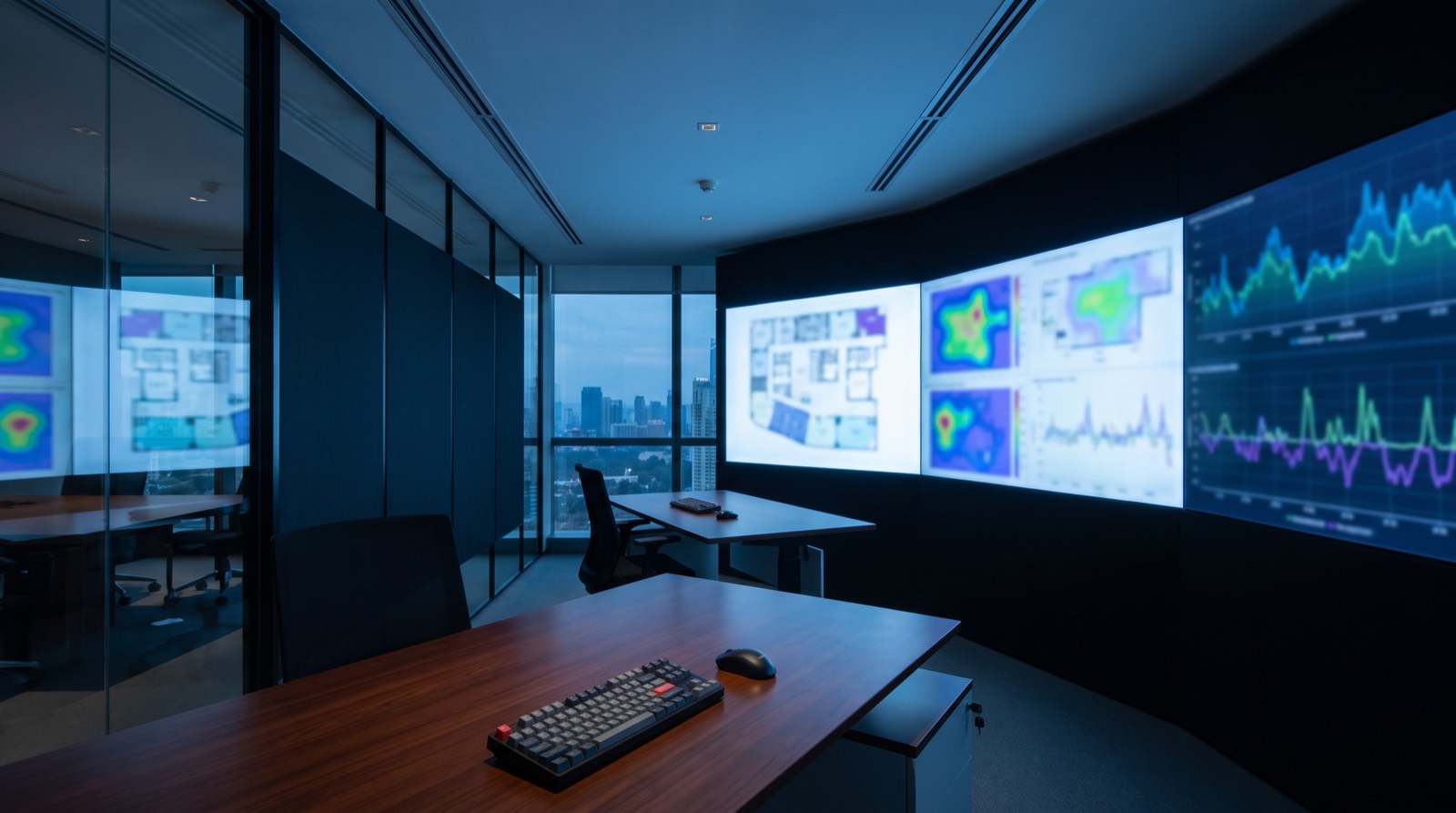
Answer up front — Aqara describes Studio as "an ontology-native spatial intelligent operating system built on spatial ontology". In practice that means the platform models a building as a hierarchy of spaces and objects rather than a flat list of devices, so an automation can be written against "Level 3 east corridor" instead of a device ID. It runs in three deployment models — hub-integrated on dedicated Aqara hardware, edge-deployed on your own server, or cloud-hosted — and that choice decides where data lives, how the building behaves during an internet outage, and who carries operational load. It speaks Zigbee 3.0, Thread, Wi-Fi, Ethernet, BACnet/IP, KNX/IP, Modbus and MQTT, which is what lets it sit on top of an existing building management system rather than beside it. Control, automation and spatial data stay on site by design.
Aqara's own industry positioning has moved from selling devices to selling spatial intelligence — perception, decision and execution across a physical space. Studio is the layer where that shift becomes concrete for an integrator. It is the first Aqara product that asks you to describe a building rather than a device list, and it is the first one where the description is the asset: it is what makes automations portable between sites, what makes a plugin installable in more than one project, and what makes an AI agent able to reason about a room.
This post covers what Studio actually is, what the three deployment models are for, and which decisions belong to you before quotation.
Ontology is a shared description of what things are and how they relate to one another. Applied to a building, the practical difference shows up immediately.
| Approach | How it describes a space | What an automation is written against |
|---|---|---|
| Flat device list | A sequence of named devices | A device ID that means nothing in another building |
| Ontology-native | Building → floor → room → zone → object and structure | A semantic path that a person, a plugin or an agent can reason about |
Aqara's documentation is explicit about why the second one matters. Studio space management provides "standardised ontological semantic modelling, which is essential for integrating third-party AI Agents or using OpenClaw for intelligent space management".
Read that as a practical commitment rather than a research paper. If your spaces are modelled semantically, then an external system — a booking system, a BMS, an AI agent — can be handed a description of a room and act on it without a bespoke mapping table for every site. That is the difference between integrating one building and integrating twenty.
Aqara documents three ways to run Studio. They are not a good-better-best ladder. They answer three different questions: where does the hardware live, where does the data live, and who operates it.
| Model | How Studio runs | Advantage | Fits |
|---|---|---|---|
| Hub-integrated | Pre-installed on M300/gateway hardware; the hub handles transport, multi-protocol parsing, configuration and automation orchestration | No extra server; everything local; very low latency | Homes, small projects, fast pilots |
| Edge-deployed | Standalone on your own edge or server hardware, with capabilities assembled on demand | Local data storage, modular, compliance-friendly | Medium and large buildings, campuses, industrial IoT, higher-security sites |
| Cloud-hosted | Delivered via cloud by rental or licence, with no local hardware | Scale on demand, team collaboration, cross-region operations and maintenance | Multi-project management, remote service, large-scale providers |
Three points on that table deserve emphasis for a Malaysian project.
Hub-integrated means the hub is the controller, not just a radio. Transport, protocol parsing, configuration and automation orchestration all happen on it. That is why control latency is very low and why the system keeps working through an internet outage — there is no cloud round trip in the path of a light switch.
Edge-deployed is the one most commercial projects should start from. You supply the server, the data stays under your control, and capabilities are assembled on demand rather than being fixed by the hardware vendor. For a building owner who has to answer a question about where their occupancy data is stored, this is the model that answers it.
Cloud-hosted is an operating decision, not a technical ceiling. It is the sensible answer when a provider runs many sites from a small team. It is the wrong answer for a building whose lights must respond during a fibre outage.
One hardware note, stated plainly: the dedicated hardware for the hub-integrated model is the Aqara Edge Hub M300, announced at IFA 2025 on 3 September 2025 as the official hardware controller for the Studio spatial intelligence operating system, acting as both a local edge hub and a gateway. Aqara's documentation lists its sales regions as Chinese Mainland, North America, Europe and Russia. It has not been listed as a Malaysian-channel product. Talk to us about availability and project fit rather than assuming it is on a shelf locally.
From the Studio documentation, the platform connects Aqara hubs, Zigbee, Matter, MQTT, KNX IP and more. The hub-integrated documentation adds the professional building set: Zigbee 3.0, Thread, Wi-Fi, Ethernet, BACnet/IP, KNX/IP and Modbus.
| Protocol | What it reaches |
|---|---|
| Zigbee 3.0 | Aqara's own range plus third-party Zigbee |
| Thread | Thread accessories, including Matter over Thread |
| Matter | Matter-enabled accessories, subject to the Matter controller rule |
| Wi-Fi and Ethernet | IP-connected devices, cameras and cloud services |
| MQTT | Message-bus integrations, commonly used to bridge to building platforms |
| BACnet/IP | BMS plant and building services |
| KNX/IP | KNX installations |
| Modbus | Metering, inverters, HVAC and industrial equipment |
The last four rows are why this is a building conversation and not a consumer one. BACnet/IP, KNX/IP and Modbus TCP are the protocols a Malaysian building operator already has equipment on. Being able to sit on top of that equipment is the difference between adding another isolated system and becoming the control layer the building already implies.
If your project involves a BMS, plan the third-party integration as a survey task rather than a discovery task. Confirm the model and firmware actually support the protocol before you commit the design.
Studio's space management is where most of the platform's real capability sits, and it is the part integrators consistently underestimate.
Define the building structure and create hierarchical spatial areas. This is the spine of the project. A region contains spaces; spaces contain zones; objects and structures are linked to them. Everything else in the platform — automations, plugins, reporting, an agent's understanding of the site — resolves against that hierarchy.
Link furniture and structures, not only devices. Aqara's documentation describes linking devices or physical entities — furniture, structures — to areas. That is a small feature with a large consequence: a space can be described by what is in it, which is what allows a plugin or an agent to act sensibly on something that is not a sensor.
Use templates, or build fully custom. Space templates allow quick creation where a building type repeats. A hotel floor, a classroom block, a serviced apartment unit — each of these is a template candidate. Where a building is genuinely bespoke, the structure can be fully custom. Decide which of your two you are before the first device is mounted, because retrofitting a hierarchy after automations are written against it is expensive.
Studio carries two visual logic tools, Classic and Flow, positioned by Aqara as zero to minimal code. Flow covers triggers and conditions, actions and data processing, and service calls.
For an integrator this is a commercial decision as much as a technical one. Logic that a client maintenance person can read and adjust is logic that does not generate a callback every time someone changes a meeting-room schedule. Draw the logic, hand over the diagram, and document what each branch does.
Where you do need code, that is what the API layer is for. Our existing write-up on the AqaraLink developer platform, APIs and SDKs covers the cloud-side API surface in detail; the plugin and open-API layer on the Studio side is covered in Aqara Studio plugins, open API and MCP.
The most important sentence in this post is that control, automation and spatial data stay on site. That is not a performance claim, it is an availability and data-residency claim.
A Malaysian building should not lose the ability to switch its lights off because a fibre circuit is down or an upstream provider is having an afternoon. In a local-first deployment, the automation that turns a corridor light off at 11pm executes on hardware inside the building, whether or not the internet is up. Cloud connectivity, where it is used, adds remote access and fleet management on top — it is not in the critical path of the switch.
The commercial implications follow from that, and they are covered in detail in choosing a deployment model for spatial intelligence in Malaysia. The short version: deployment model determines data location, outage behaviour and who carries the operating load.
Aqara's published reference cases include high-rise residential, telecom and smart-office deployments in Sri Lanka and South Korea, and a fine-arts academy in China. In a hotel or serviced apartment, the hierarchy you build — region, floor, room type, room — is what allows the same automation to be rolled out across every room instead of configured 200 times. That vertical case is set out in spatial intelligence for hotels and serviced apartments in Malaysia, alongside the operating model in hotels, serviced apartments and offices.
Spatial intelligence deployment model compared for Malaysia: hub-integrated, edge-deployed and cloud-hosted, covering data residency, outages and workload.

Aqara Studio plugin API guide for builders: the plugin lifecycle, Cloud Connect as a prerequisite, the Local API, and the MCP interface for AI agents.

AqaraLink developer platform API explained for integrators — cloud modules, message push, virtual accounts, App SDKs and the Matter path. Malaysia support.
Tell us about your space. Our B2B team will reply within one business day with a recommended setup and quotation.
WhatsApp us →
[email protected]
+603-5880 5486