







Which Smart Home Retrofit Is Realistic in Malaysia? By House Type
Smart home retrofit Malaysia house type: what is easy, what is painful, and what it costs to start - terrace, shop lot, walk-up and new high-rise unit.
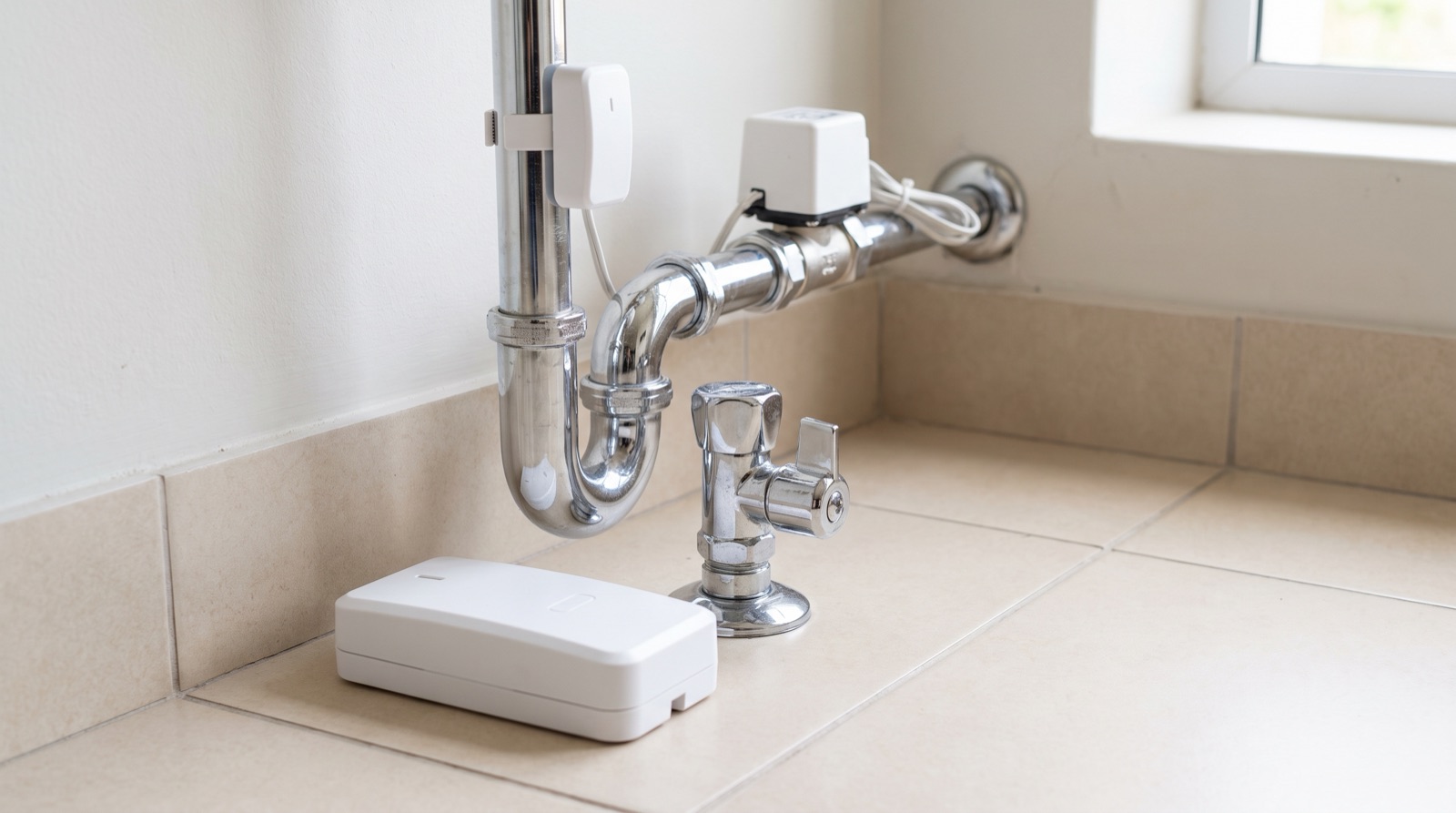
Answer up front — A leak sensor only protects the client if it sits where water actually arrives, and the water only stops automatically if there is a motorised valve on the pipe that something can drive closed. That shut-off is a plumbing decision as much as an electrical one: a motorised water valve, driven through a suitable relay or controller, specified per site with your plumber, fitted where it is accessible and isolates what you think it isolates. Everything else on this page is placement detail around that one decision.
Most installs waste sensors in dry rooms. The high-hit positions in Malaysian homes, in the order they actually get used:
| Position | What it catches | Priority |
|---|---|---|
| Under the kitchen sink, on the waste trap | Burst flexi tail, perished trap washer, dishwasher inlet or waste | Always |
| Washing machine feed hose, at the machine end | The most common domestic flood in this country. These hoses fail at the crimp | Always |
| Water heater riser and the isolation valve above it | Joint weeping, heater integrity, the feed into the heater | High on any house with a storage heater |
| Main incoming pipe, after the meter, before the house splits | Everything downstream of one point | High, and the only position covering a whole-house event |
| Toilet cistern feed and its angle stop | A slow weep that would run for weeks behind the pan | Medium, and cheap to add while you are at the WC |
| Bathroom basin waste | Hidden slow leaks under tiles | Medium, one per bathroom |
| Header tank and the pipework below it | Overflow, failed float, tank-to-ceiling pipe | High on a landed with a roof tank |
| Aircon condensate tray and drain pipe | A slow drip that soaks a wall or ceiling over months | Medium, and never in the client's mental model |
A single sensor in a three-bathroom house, because it is a point sensor and not a circuit — cover the wet rooms properly or do not bother. A sensor on top of a fridge or a high shelf in a store, where it will never see water. A sensor behind a bin in the utility corner, unreachable and untestable, which means dead within two years. And a sensor mid-floor of a ceiling void, which is worth having but should be sold honestly as after-the-fact detection — it reports only once the ceiling is already ruined.
The habit worth installing: every sensor should be reachable and testable without moving furniture. Walk them through it at handover.
Sensors raise an alarm. Only a valve stops the water. The Aqara side of the design is the detection and the automation: a Water Leak Sensor T1 in each wet position, and an automation on the hub that fires when one of them reports. The shut-off itself is a motorised water valve driven through a suitable relay or controller, specified per site with your plumber. That split is the whole design decision, and it is where jobs go wrong.
Requirements on the valve and its drive:
Then the plumbing decision, which is not an electrical one:
| Scope | What the client gets | What it costs you |
|---|---|---|
| Whole-house, after the meter | One event shuts everything. Simplest to commission, most robust | Every event cuts drinking water until someone reopens it, which nobody likes at 2am |
| Wet-zone branch | Only the affected zone stops; the rest keeps running | More pipework, and only works if the branch is already isolable or you create it |
| Per-fixture isolation | Tightest control | Several motorised valves and drives, a much larger first-fix. Rarely worth it on a house |
Be honest in the quote: fitting a motorised valve into the pipe run is plumbing work. That is a plumber, working to their own trade rules. A line item and a schedule item, not something to absorb on commissioning day.
Check the fail position before you sell it. Whether the valve closes, stays put or opens on loss of power is a datasheet question for the valve you chose. If the client's water also comes from a generator-backed pump or a tank, find out what happens to the pump. A valve that cannot close when power is out turns a leak into a flood.
Same discipline, different logic, because the hazard behaves differently.
Smoke. On the ceiling, because smoke rises and a wall-mounted unit sees it late. Away from the door — a closed door is exactly when you need the warning, so never put the only unit outside the room. Away from aircon supply diffusers, which pull smoke away from the unit, from a kitchen extract hood, and from the bathroom door where steam is a daily false alarm. Not in a corner: smoke stratifies along the ceiling and a corner unit sits in a dead zone. Multiple units, connected if the client wants an interlinked system, and a test button pressed monthly. Whether a given model carries a specific certification is a datasheet question — check it, and do not assume a smart unit is a listed alarm unit.
Gas. A combustible gas sensor and a carbon monoxide alarm are different instruments and do not substitute for each other. A gas sensor belongs low, near the point of use, and — for bottled LPG — close to and above the cylinder, where the gas collects if it leaks. A CO alarm belongs at breathing height in sleeping areas, because CO is the one that kills people asleep. Placement guidance and detection thresholds both come from the manufacturer's datasheet; the threshold numbers are not something to improvise on site.
Outdoor and wet-area mounting is a separate decision. Any unit going into a carport, balcony, bathroom ceiling void or outside face needs the datasheet's IP rating checked against that exact location, and a mounting surface that holds it.
This is the paragraph that protects you from an expensive conversation later, and it should be said out loud at quote stage, in writing.
What it genuinely is: the cheapest way to turn a silent, slow, invisible domestic water event into a loud one, within minutes, at a cost the client will accept. That is a real payoff. It is just not the one people imagine when they buy it.
Decide this during commissioning, not when the client calls.
| Element | The options | The honest note |
|---|---|---|
| Who gets told | Push only; push plus an in-home siren; push plus an external sounder | Push only will not wake anyone and will not be read until morning |
| What the automation does | Cut the water, kill the water heater, kill the aircon, drop the lights to a low scene | Cutting the heater and aircon is what stops a small event becoming a damaged ceiling; test those loads are on the automation at commissioning |
| Whether the hub is alive | A notification needs the hub online and the router powered | If the notification has to get out during a power cut, that is a UPS decision, and it belongs on the placement plan |
| The rearm | Someone has to dry the sensor, clear the fault and reopen the valve | Nobody rebuilds a rearm allowance into a quote. Put a return-visit line in the schedule instead |
Two more things at handover. The alarm has to be recognisable — a distinct notification sound or a repeated notification, because "some app on my phone went off" is not something anyone responds to. And the client must know who to call at 3am, which is a person, not a platform.
On the handover sheet: every sensor position, by room and by what it protects. The valve position and which circuits it isolates — half the value of an automation is knowing what it actually cut. The fail position on loss of power, quoted from the datasheet. The notification contact and the agreed after-hours escalation, which turns a notification into a response. The test interval, in the client folder rather than in your head. And an explicit statement of what the system does not do, which is the paragraph above, in writing.

Smart home retrofit Malaysia house type: what is easy, what is painful, and what it costs to start - terrace, shop lot, walk-up and new high-rise unit.

From the official Aqara Malaysia distributor: the current range, which products need a neutral, back box and gang needs, aircon loads and local support.
A sirim smart switch malaysia compliance guide — what to check before buying mains-powered gear, who may do the wiring under Act 447, and where PDPA applies.
Tell us about your space. Our B2B team will reply within one business day with a recommended setup and quotation.
WhatsApp us →
[email protected]
+603-5880 5486