







Smart Hotel Room Automation in Malaysia: What Operators Actually Buy
Smart hotel room Malaysia guide: the device decisions per guest room, what the guest controls against what staff control, the cooling load and PDPA duties.
Answer up front — The guest room is the visible part of a hotel's smart system, and the back of house is where the operating cost actually sits. Aqara covers four things well there: telling staff and guests that a room is being cleaned so nobody walks in, controlling staff access and key overrides, switching the kitchen, laundry, corridor and lobby loads off when nobody is there, and detecting intrusion or a leak in plant rooms after hours. What it does not do is integrate with your property management system, replace a compliant access-control system, or stand in for a certified fire alarm. None of those are small print — they decide whether the project is worth doing. If your hotel's problem is guest-facing convenience, read the guest-room post first. If it is operating cost and staff workflow, this is the one that matters.
A hotel's smart building project is usually scoped around the guest room, because that is what gets photographed and what a guest notices. The corridor, the kitchen, the laundry, the plant room and the staff entrance are where the money is actually spent and where most of the operating waste sits. This post covers that half of the building.
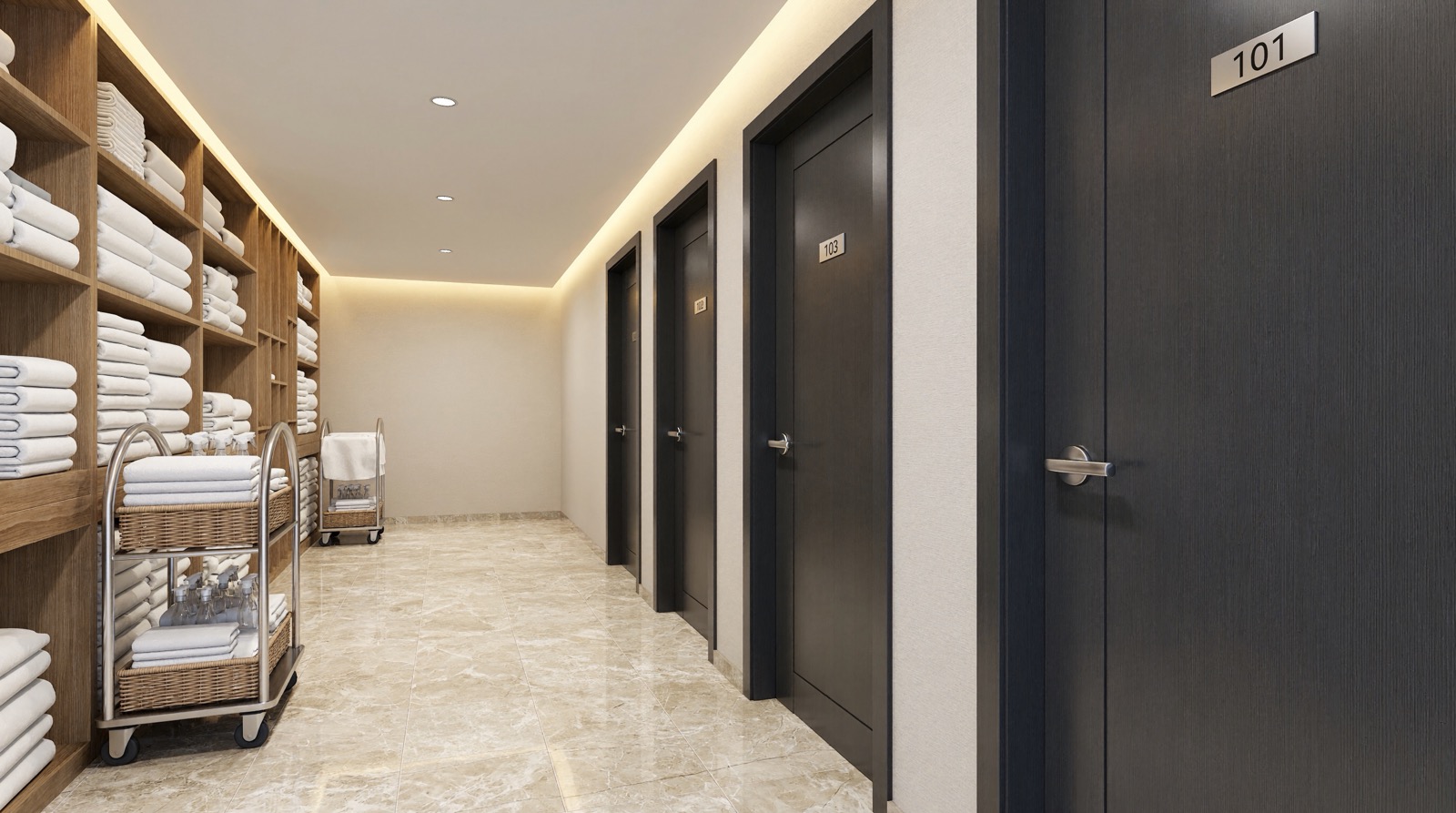
Here is the scenario that causes the complaints. Housekeeping enters room 814 to clean it. The guest is still in the room, or has just left and is walking back down the corridor. The door is locked, so the guest cannot get in and the cleaner cannot get in, and both of them are now standing in a corridor.
The usual fix is a physical do-not-disturb indicator on the door. It works. It also fails in three predictable ways: the cleaner forgets to turn it, the guest does not notice it, and it says nothing to the hotel once the door is closed.
The smart version is a status that both sides can see. A door contact on the room door reports open and closed. A motion and light sensor in the room reports whether someone is inside. The doorbell camera or a camera in the corridor can confirm it visually. Put together, those three signals tell the desk that a room is occupied, that it is being cleaned, or that it is empty — and can drive a screen at the housekeeping base.
The Aqara devices that do this:
| Job | Device | Notes |
|---|---|---|
| Room door open/closed | Door and Window Sensor P2 | Matter over Thread; instant open/close alerts; thin magnet included |
| Is anyone in the room | Presence Multi-Sensor FP300 | PIR plus 60 GHz mmWave, so it still detects a person sitting still; also reads temperature, humidity and light |
| Is there movement | Motion and Light Sensor P2 | Thread, battery powered, with an illuminance sensor |
| Corridor and room check | Camera Hub G3 | 2K, 340° pan, on-device face, gesture and pet recognition, local microSD up to 128 GB |
The honest limit: presence detection in a hotel room is not a person count. The FP300 tells you the room is occupied, not how many people are in it, and a guest lying still on a bed reads the same as a guest reading a book. If your operation depends on knowing how many people are in a room — for housekeeping productivity, for safety, for occupancy reporting — this is the wrong tool and you need a different class of sensor. What it is good at is the binary that housekeeping actually needs: is this room finished, in progress, or occupied.
Hotel staff move constantly. Housekeeping enters every room. Maintenance enters plant rooms. Managers enter offices at odd hours. Each of those movements is either a key on a ring, a code on a card, or a lock someone overrides.
A smart lock changes that balance in three ways:
The Aqara range covers the cases an operator actually has:
| Case | Model | Key point |
|---|---|---|
| Room door, staff and guest access | Smart Lock U300 | Lever handle; fingerprint, PIN, NFC and Apple Home Key; Matter over Thread |
| Retrofit onto an existing deadbolt | Smart Lock U200 | Mounts inside; outdoor keypad with fingerprint, PIN and NFC; keypad rated IPX5 |
| Retrofit, simpler | Smart Lock U200 Lite | Fits over an existing deadbolt; auto-lock; rechargeable battery |
| New build, no hub wanted | Smart Lock B50 | Built-in Wi-Fi 6, so no hub; about six months on four AA batteries; USB-C emergency power |
| Full mortise with face recognition | Smart Lock D200i | 3D face recognition alongside fingerprint, PIN and NFC |
Two things to settle before you order. First, the door decides. Aqara publishes no door thickness figures for any lock model, and the retrofit models assume a conventional deadbolt rather than a mortise in a fire-rated door. That is confirmed at the site survey, not at the product page. Second, these are not a compliant access-control system. They are smart locks, not a credential-managed reader network. If your hotel's access control is driven by a compliant system for a reason — audit, fire safety, licensing, or the management company's own policy — the smart layer sits beside it, not on top of it.
Our access control and after-hours operation post covers the operating model in more depth, and guest access without lending keys covers the guest side.
The guest room is a small load. The kitchen, the laundry, the cold store, the corridor lighting and the lobby are where a hotel's electricity bill is made.
Four controls do most of the work:
The limit worth stating plainly: a switch that is told to turn off an air conditioner does not turn off the compressor that is already running, and it cannot tell you what the unit is actually drawing unless it has power monitoring. The 20A switch does have energy monitoring. Most wall switches do not. If you want a verified energy figure rather than a switch state, you need a device that measures — and the measurement has to come back through a hub.
A hotel's worst incidents after midnight are not burglaries. They are water, smoke, gas and an unlocked door that nobody knew was open.
| Risk | Device | Published detail |
|---|---|---|
| Water ingress | Water Leak Sensor T1 | IP67 waterproof; instant alarm and push notification; Zigbee 3.0; pairs with valve shut-off automations |
| Smoke | Smoke Detector | Aqara publishes a current model in this category |
| Gas | Smart Gas Detector | Aqara publishes a current model in this category |
| Air quality | TVOC Air Quality Monitor | TVOC, temperature and humidity on an E Ink display; over one year of battery life; magnetic mount |
| Temperature and humidity | Climate Sensor W100 | Reads both; also acts as a wireless controller; −20 °C to 60 °C |
| A cabinet or safe being disturbed | Vibration Sensor T1 | Detects vibration, tilt and drop; adjustable sensitivity; can sound the hub siren |
The leak sensor is the one most hotels under-specify. A laundry, a kitchen, a roof void and a plant room are four different leak risks, and an IP67 sensor costs very little next to a flooded floor. The vibration sensor covers the cases people forget: a service door being forced, a safe or a back-office cabinet that should not have been opened.
Where the site-level view comes from. Aqara tells you what happened in a room. It does not tell you how the building is being used across the night — who is in which zone, which floors are in use, whether the night staff are doing their rounds. That is the layer where Omaya, Synchroweb's own IoT platform, sits: roll call, lone-worker check-in, panic escalation, after-hours intrusion, device health with firmware and last-seen, environment monitoring with evidence-ready logs, and 30 report types. Our Aqara presence sensors versus Omaya occupancy post explains the split in full.
Say this in the tender, not after the handover.
For the guest-facing half, our smart hotel room in Malaysia post covers the room itself, and hotels, serviced apartments and offices covers the mixed-use case where the same building has a hotel in it and other tenancies above.
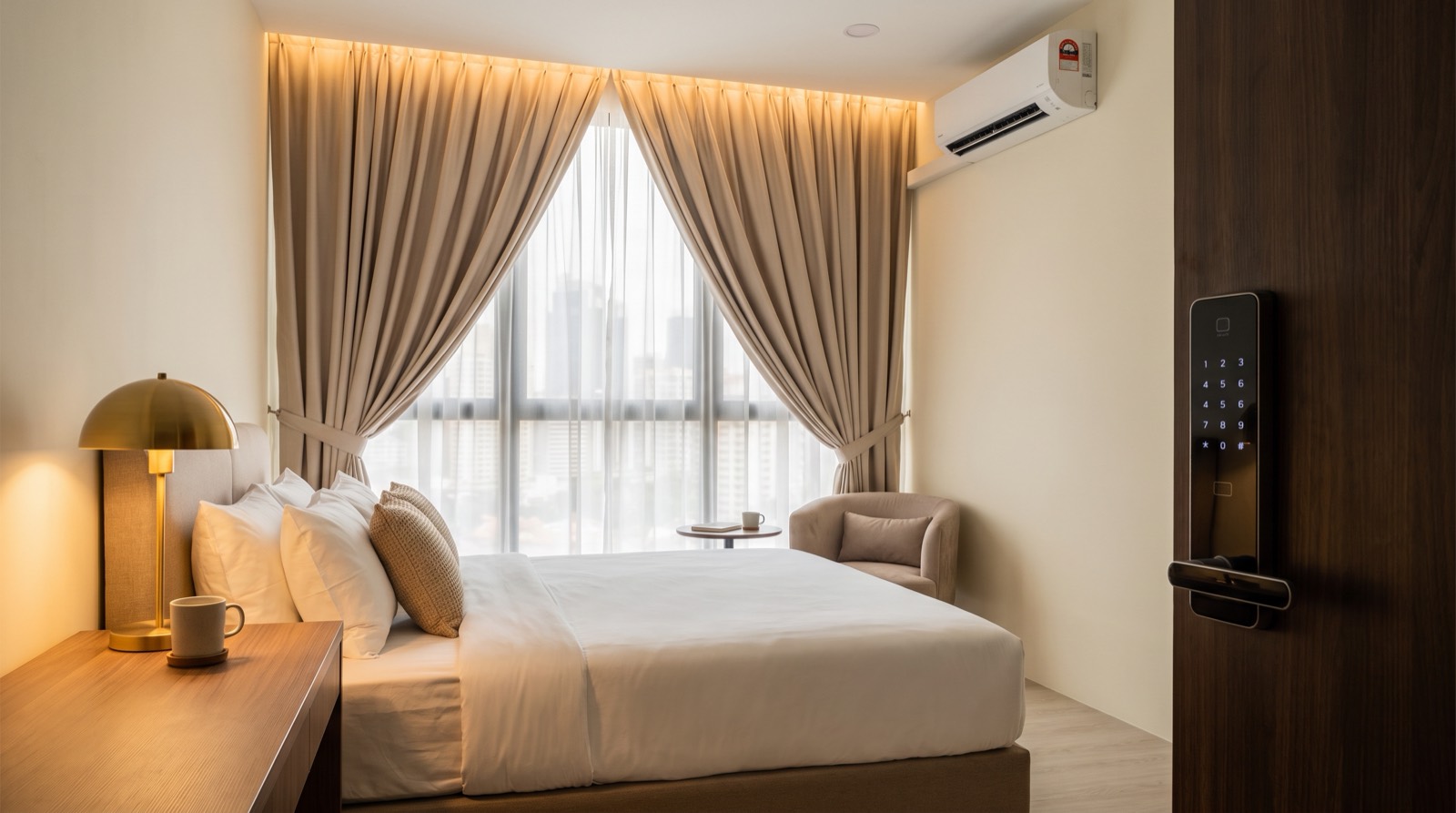
Smart hotel room Malaysia guide: the device decisions per guest room, what the guest controls against what staff control, the cooling load and PDPA duties.
Smart hotel Malaysia: the AqaraLink Industry Application Platform for hotels, serviced apartments and offices, and the operational questions operators ask.
Smart hotel Malaysia explained through occupancy: after-hours energy cost, real room turnover, the guest and operator split, and PDPA for occupancy data.
Tell us about your space. Our B2B team will reply within one business day with a recommended setup and quotation.
WhatsApp us →
[email protected]
+603-5880 5486