







Which Smart Home Retrofit Is Realistic in Malaysia? By House Type
Smart home retrofit Malaysia house type: what is easy, what is painful, and what it costs to start - terrace, shop lot, walk-up and new high-rise unit.
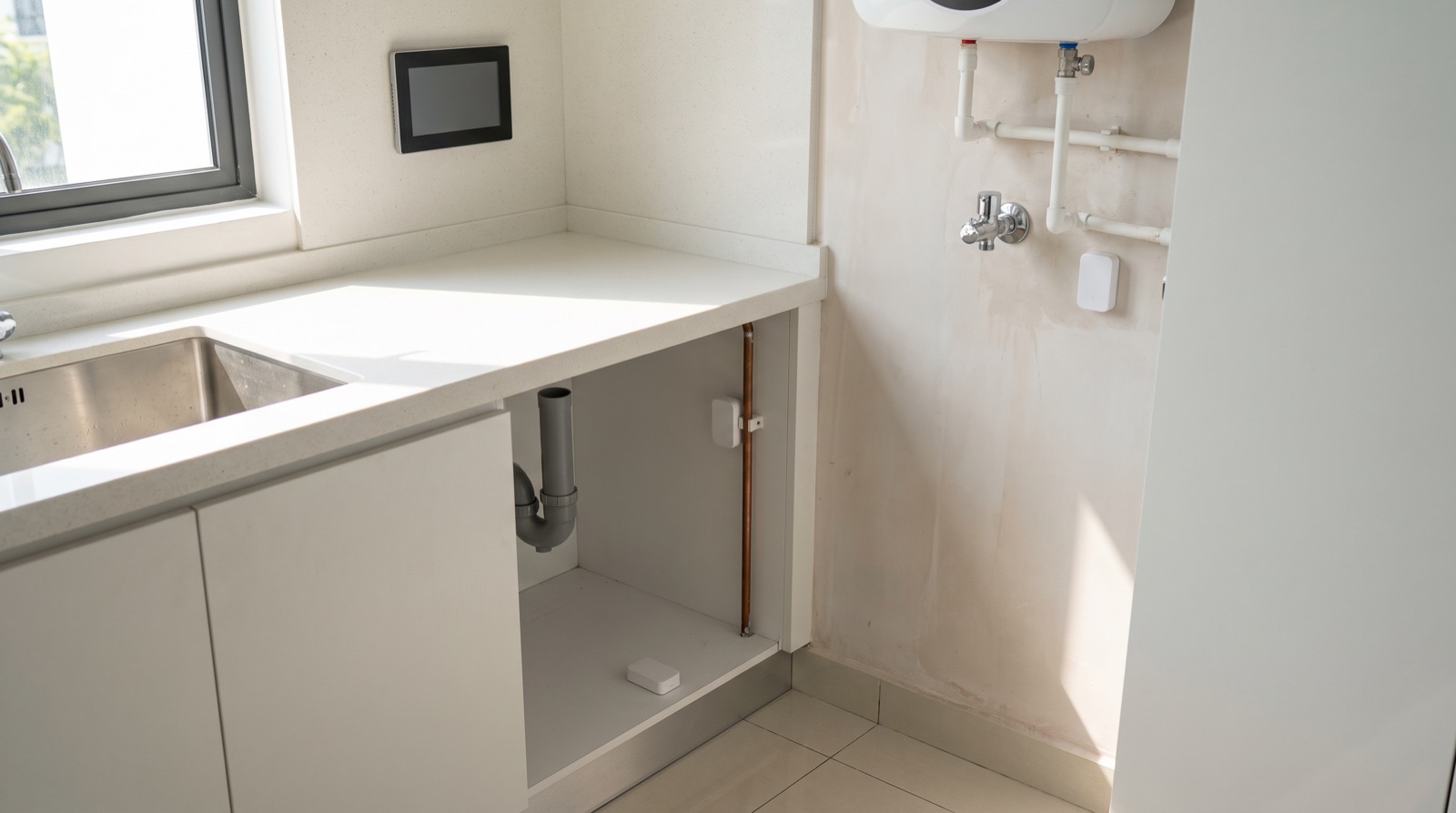
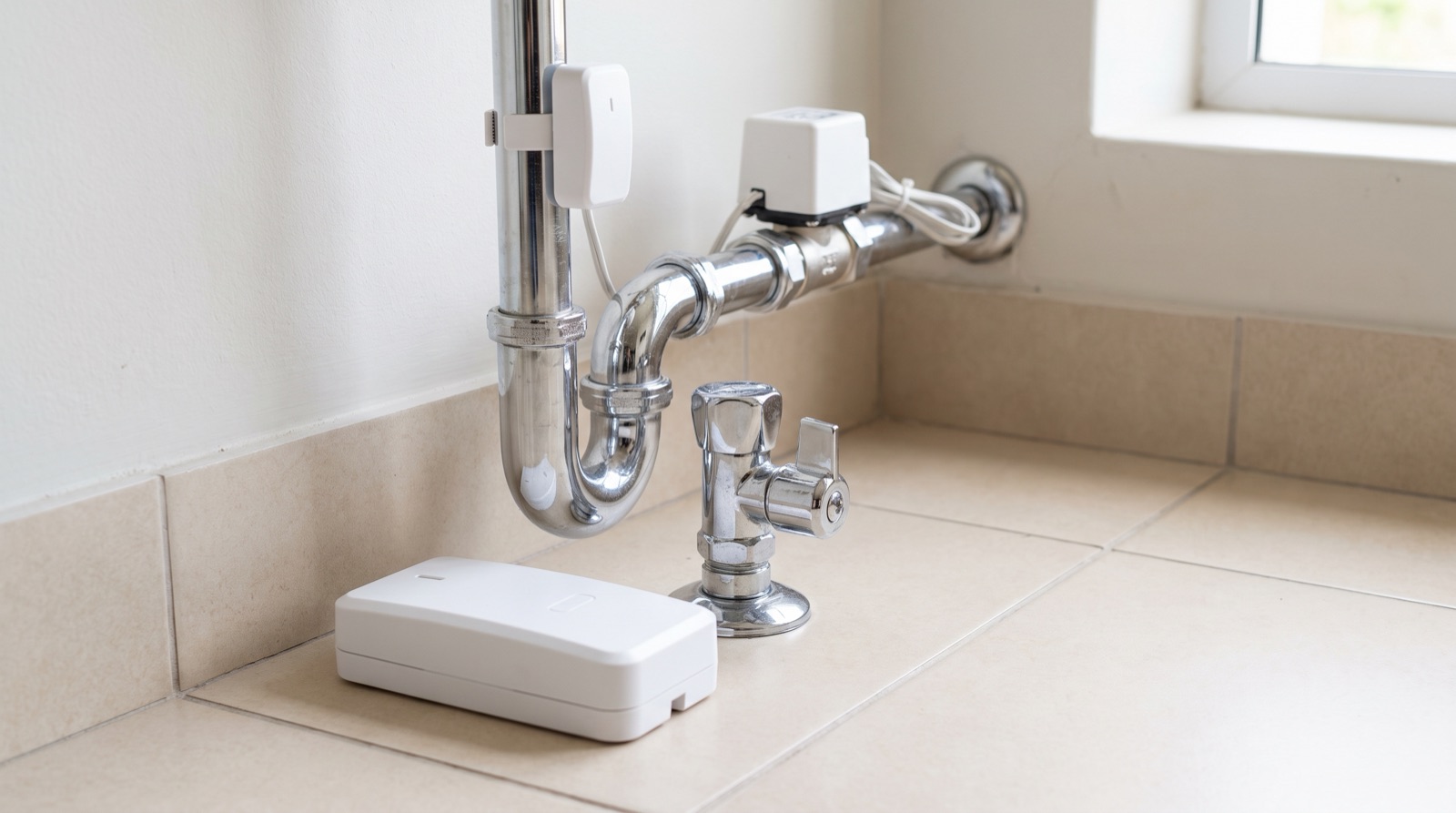
Answer up front — Almost every flood in a Malaysian kitchen starts at one of five places: the washing machine inlet hose, the waste trap under the sink, the water heater inlet, a bathroom ceiling below an upstairs wet area, or a fridge water line if you have one. A water leak sensor such as the Aqara Water Leak Sensor T1 tells you that water arrived. A motorised shut-off valve, triggered by that sensor, can stop it. Neither one repairs a perished hose. Fix the hose first, then decide what the sensor is for.
Not the theoretical list. The five that fill actual Malaysian kitchens and bathrooms, in roughly the order they cause damage:
| Point of failure | What goes wrong | How it fails | Where the sensor goes |
|---|---|---|---|
| Washing machine inlet hose | The braided flexi hose splits or the crimp lets go | Sudden, loud, whole floor wet within minutes | At the machine end, on the floor, reachable |
| Sink waste trap under the sink | Trap washer perishes, a joint weeps, tailpiece cracks | Slow drip first, then a steady flow onto the cabinet base | On the trap itself, not tucked behind the bin |
| Water heater inlet | The cold feed into the storage heater seizes or the joint cracks | Intermittent, and it is running while nobody is home | On the floor at the heater base |
| Bathroom ceiling, below an upstairs wet area | Water travels through the slab and down a conduit | Slow, hidden, found by the downstairs neighbour | On the upstairs wet-area floor, near the basin and floor trap, so you hear about it before the stain spreads below |
| Fridge water line (if you have one) | Line frays behind the fridge where nobody looks | Very slow, discovered by smell or a swollen baseboard | At the fridge end, and pull the fridge out to reach it |
Two of those five are the ones people actually forget. The trap under the sink is the single most common source of a slow water event in this country, because the trap washer is the cheapest part in the kitchen and it dries out. The bathroom ceiling is the most expensive, because by the time you see it, the tile above has already been wet for a while.
This is the flood everyone pictures, and the reason it happens is boring: an inlet hose left in service past its life, or a machine installed without a flood tray, or both.
The honest sequence is: replace the hose, then fit the sensor. A sensor on top of a nine-year-old hose is a very expensive way to be told something you could have prevented. If the machine is fed by a braided stainless hose and it looks clean, undented and recently changed, fine. If you do not remember when it was last changed, that is your answer.
Where the sensor goes: on the floor at the machine end of the hose, where a split will put water onto it almost immediately, and where you can reach it without moving the machine. Not taped up on the wall behind the machine, where it will report a week late.
Most people only open that cabinet when the pipe is already blocked. That is the wrong time.
What is in there: a bottle trap or an S-trap, a rubber or plastic washer where the trap screws into the tailpiece, and a flexible tail from the trap into the wall. The washer is the weak point. It dries, it hardens, it stops sealing, and you get a drip onto the cabinet base that either soaks into the wood or sits in a puddle you do not see because the cabinet has a solid bottom and the bin is in the way.
This is the best case for a sensor, and the reason is the speed. A weeping trap does not burst. It drips, for weeks, quietly, and the damage is mould in a plywood base you will one day have to cut out. A sensor on the trap floor turns months of silent damage into a notification the week it starts.
Two habits worth building now: put something under the sink to catch a drip so you can see it, and look. And when the plumber is there for anything at all, ask them to replace the trap washer. It costs almost nothing.
Every home with a storage water heater has a cold inlet pipe, an isolation valve and a whole lot of threaded metal joints, and all of it gets touched every time someone services it.
The sensor position is straightforward: on the floor at the base of the heater, inside the bathroom if that is where it lives. Two things to be careful about. The isolation valve on the heater feed should be somewhere a person can actually reach and turn — a valve behind the heater that can only be turned by removing the heater is not an isolation valve, it is decoration. And a heater feed plumbed into a ceiling void or a tank is a different job; that is a plumber's conversation, not a weekend one.
In a landed or terrace with bathrooms stacked, this is the one that produces a genuine argument between neighbours, because the water did not start on the floor you are standing on.
The path is usually: a wet area above, water getting into a slab or a concealed pipe, tracking along the slab, and then reappearing through a conduit, a downlight hole, or a joint in the ceiling below. By the time it shows, the leak has been running.
A sensor on the upstairs wet-area floor is worth having precisely because the alternative is a brown stain. Be clear about what it buys you: it is after-the-fact detection. Water has already escaped by the time the sensor sees it, and a leak inside the slab may never reach the sensor at all. Its value is that you find it in a day instead of a month, which is the difference between a dried patch and a demolished ceiling.
The fix for the actual cause is upstairs. Talk to the neighbours. This is one of the few smart home problems where the technology is the least important part.
Most Malaysian kitchens do not have one. If yours does — a fridge with an internal water dispenser and a plumbed line — then you have a hose that nobody looks at, running behind an appliance that gets pushed back against the wall every time you clean.
Same rule. Sensor at the fridge end, floor level, and when you are in there, check the line and the compression fitting while you can see it. If the fridge is a rental or a hand-me-down, the line is likely older than the sensor.
| Leak sensor | Motorised shut-off valve | Replacing a perished hose | |
|---|---|---|---|
| Tells you water arrived | Yes | No | No |
| Stops the water | No | Yes, if it can reach a valve it can turn | No, but it removes the cause |
| Works when you are not there | Yes, if the hub is powered and online | Yes, on the same condition | Yes, always |
| Stops a burst quickly | No | Yes, once the leak sensor triggers it | Removes the risk at source |
| What it involves | A battery sensor | The valve actuator, a suitable valve and the plumbing | A plumber's visit, small if you catch it early |
| Needs a tradesperson | No, battery and mount | Plumbing access, plus power for the actuator — check the datasheet | A plumber |
Read that table again before you buy anything. The honest pitch is: the sensor tells you, the valve stops the water, and neither is a substitute for maintenance. A motorised valve bolted to the wrong end of the pipework can protect a tap you never use while the washing machine floods the floor. Where it goes determines whether it helps.
Some valve controllers clamp onto a valve you already have; others replace a section of pipe. Either way, confirm the valve type the actuator supports on its datasheet — a clamp-on actuator needs a valve it can physically grip and turn, and a lever-handled ball valve is the usual target. It also needs to be somewhere a person can reach, because somebody will have to reopen it after a fault.
Where it earns its keep:
Where it does not:
This is the case for the whole product category, and it deserves a straight answer.
A burst inlet hose fills a floor. Mains water does not stop on its own. If the house is empty — everyone at work, everyone on a Hari Raya trip, the unit empty while you are overseas — the difference between finding out in an hour and finding out in two days is the difference between a mop and a rebuilt floor, a drying bill, and a neighbour's ceiling.
What protects you in that window, in order of how much it actually matters:
Also plan the 2am version, because a system that shuts your water off and does not tell you how to turn it back on is a system you will disable within a month. Somebody has to know where the valve is, which is a handover conversation, not a device feature.
Steps one to three cost less than the devices and prevent more damage than the devices do. Do them first.
Smart home retrofit Malaysia house type: what is easy, what is painful, and what it costs to start - terrace, shop lot, walk-up and new high-rise unit.

Smart home cost in Malaysia: rough RM500, RM2,000 and RM10,000 budget bands, what each one typically covers, and why installation labour is a separate line.
Water leak sensor placement for Malaysian homes: where leak, gas and smoke sensors belong, how to plan an automatic water shut-off, and what sensors honestly do not do.
Tell us about your space. Our B2B team will reply within one business day with a recommended setup and quotation.
WhatsApp us →
[email protected]
+603-5880 5486